



Le sculture di Ivan Theimer, nelle gallerie MARCOROSSI
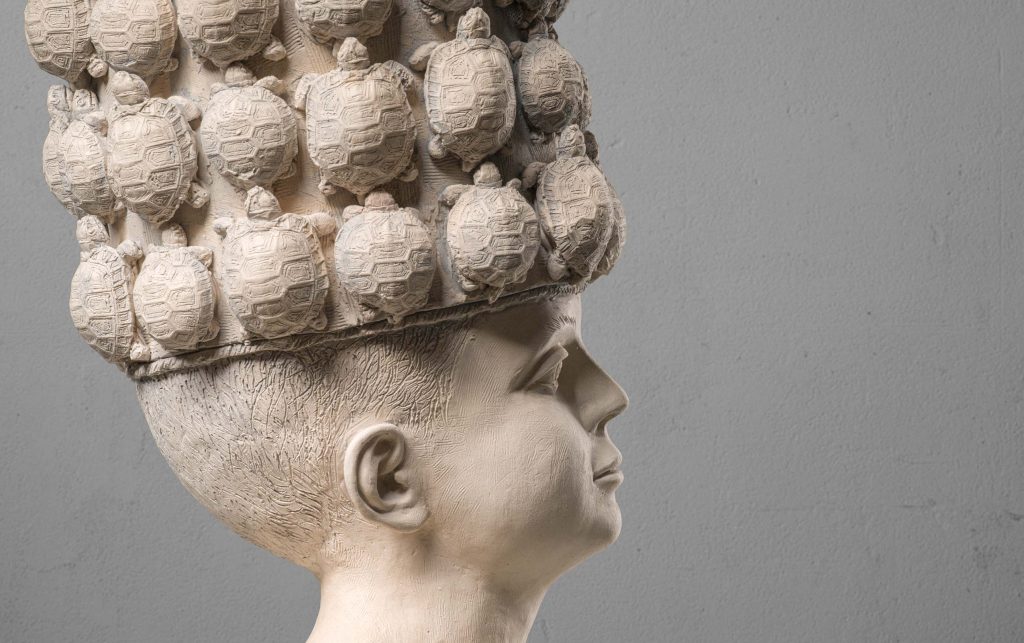
The sculptures of Ivan Theimer at the MARCOROSSI galleries
From the Monument to the Rights of Man in Paris to the Venice Biennale, the artist who brought Mediterranean myth back to the squares of Europe presents Terrecotte in Milan, Verona and Turin.
From 4 November 2026 the MARCOROSSI galleries in Milan, Verona and Turin present Terrecotte, an exhibition by Ivan Theimer in three stages: Milan from 4 November, Verona from the 7th, Turin from the 12th. Each venue shows seven terrecotta sculptures, all different, unique works modelled and individually finished by hand, and each venue also hosts a different work: a shield with the head of Medusa and two large stelae. The critical essay is by Massimo Bertozzi and will also appear in the monograph on the terrecottas that the Gallery is preparing.
From Olomouc to Paris
Ivan Theimer was born on 18 September 1944 in Olomouc, Moravia, into a family that loved art and music. He studied at the School of Decorative Arts in Uherské Hradiště.
In August 1968 the tanks of the Warsaw Pact put an end to the Prague Spring. Theimer already had a passport in his pocket, obtained to see the Matisse exhibitions in Paris and Nice. In September he left the country by train, travelling through Germany, and arrived in Paris. A scholarship took him to the École nationale supérieure des Beaux-Arts.
He is an exile who does not feel exiled: “a fuoruscito”, an émigré by choice, as Bertozzi writes. In his early Paris years he modelled a multitude of small terrecotta heads: portraits of people he knew and loved who had stayed behind the Iron Curtain. It was his way of holding on to his memories. Alongside the heads came the Landscapes, accumulations of objects and debris of history, also kneaded and fired.
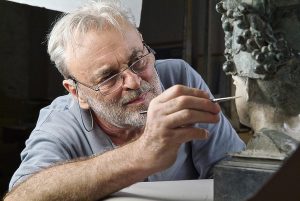
The years of recognition
His first solo exhibition came in 1971, at Armand Zerbib’s gallery in Paris. Collectors in Lyon, Geneva and Italy followed. In 1978 Theimer was invited to the French Pavilion at the Venice Biennale; he returned in 1982 and, in 1995, took part in the great exhibition at Palazzo Grassi marking the Biennale’s centenary.
In 1989 Paris celebrated the bicentenary of the Revolution and commissioned him to create the Monument to the Rights of Man on the Champ-de-Mars, at the foot of the Eiffel Tower. For the Élysée Palace he made a group of bronze obelisks; other works entered the National Library. The obelisk became one of his recurring forms, culminating in the forty-metre monument in Place de la Victoire in Bordeaux.
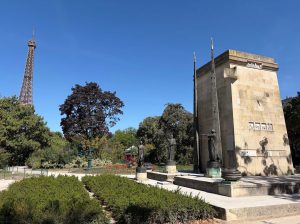
Paris – Monument to the Rights of Man on the Champ-de-Mars
Homecoming
After the Velvet Revolution of 1989 Theimer renewed his ties with his homeland. In 1996 Václav Havel dedicated a retrospective to him at the Belvedere of Prague Castle. In Olomouc he created the Arion Fountain, inspired by the myth of the lyre player saved by a dolphin, and a turtle for the city’s children. In Uherský Brod he made the monument to John Amos Comenius, the father of modern pedagogy, and the Via Lucis obelisk. In 2016 the Czech Ministry of Culture honoured him for spreading Czech culture around the world.
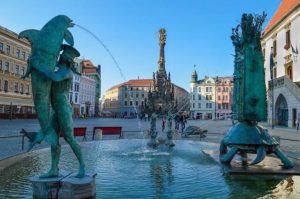
Olomouc – Arion Fountain
Italy and Versilia
For decades Theimer has lived between Paris and Monteggiori, in the hills above Pietrasanta, where he has his studio. Italy has devoted major exhibitions to him; among the most recent are Il sentimento del tempo at CIAC in Foligno in 2015, Selva simbolica at the Fondazione Accorsi-Ometto in Turin in 2021 and, in 2025–2026, Da valicate frontiere in Cividale del Friuli, at the Monastery of Santa Maria in Valle, the complex of the Lombard Temple (Tempietto Longobardo). Alongside sculpture he paints in oil, makes travel watercolours (China, India, Bhutan, Mongolia) and, in recent years, has designed sets and costumes for opera.
The works on show
The sculptures of Terrecotte carry on their heads the symbols of his universe: a tower of turtles climbing towards the sky, crowns of olive and wild olive, vine shoots and bunches of grapes, a fish, a hat crowded with tiny faces. Their face is always that of young Tobias, the biblical traveller whom Theimer imagines riding two turtles: the image of Festina lente, which is also the rule of terrecotta.
Festina lente, “make haste slowly”, is an ancient motto that urges us to act with resolve but without haste, combining drive and caution. According to Suetonius it was one of the emperor Augustus’s favourite maxims. In the Renaissance it became an image: Aldo Manuzio, the great Venetian publisher, rendered it as a dolphin wrapped around an anchor, speed joined to stability; Cosimo I de’ Medici as a turtle carrying a wind-filled sail on its shell. The turtle and the dolphin are two animals dear to Ivan Theimer, who also finds in the motto the rule of terrecotta: clay must be modelled quickly, before it hardens, and then dried and fired slowly so that it does not crack.
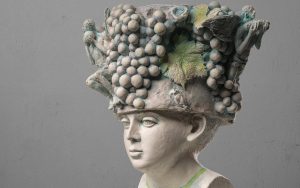
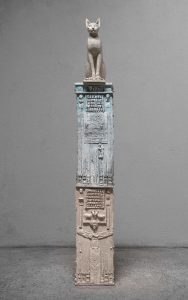
The exhibition also features three other sculptures: the shield with Medusa, which takes up the Gorgon of classical myth, her gaze frozen by the hero and her mane of snakes turned into ornament, and two stelae that are “small votive altars of poetry”: faces, cypresses, donkeys, turtles, hedgehogs and dolphins and, on top of one of them, a cat, “the least tameable of all”.
Openings: Milan, Wednesday 4 November; Verona, Saturday 7 November; Turin, Thursday 12 November 2026.